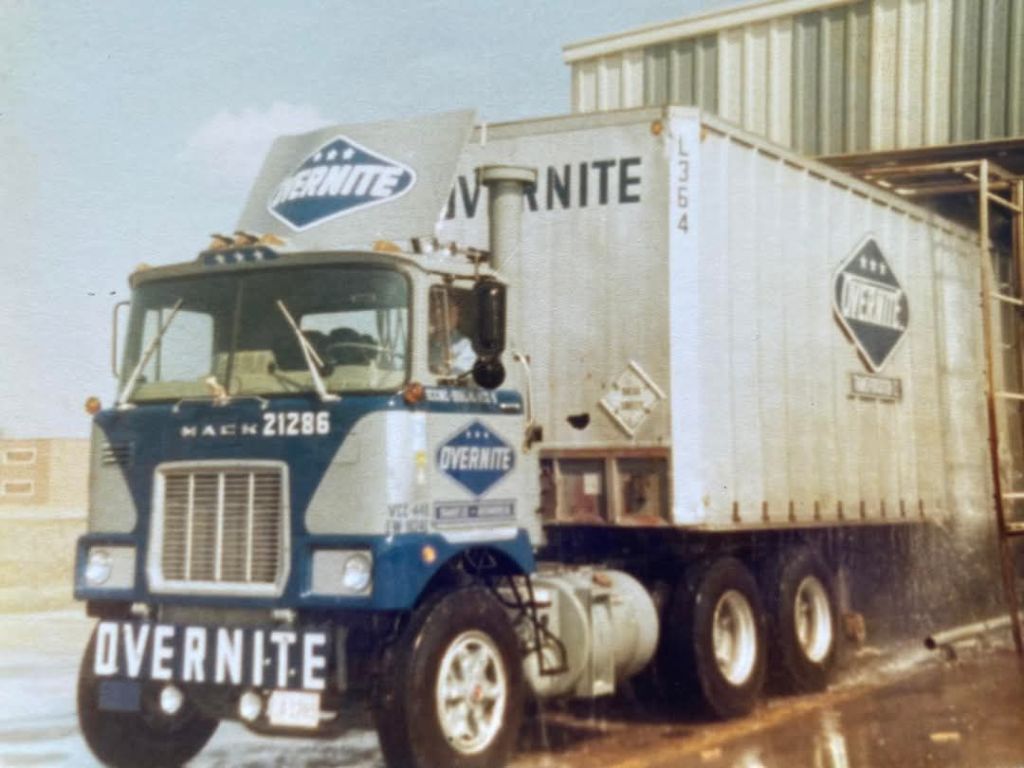
Chapter 6; My First 6 Months At Overnite

On my very first night working the dock at Overnite Transportation Company, I was assigned to unload a 48-foot trailer full of Revlon cosmetics. It looked like a million cases stacked from floor to ceiling. Honestly, I felt like turning around, walking off the dock, and quitting right then and there.

But with God’s patience—and the grit He gave me—I stuck it out. I started separating and organizing the freight, doing my best to make sense of it all. About an hour in, Mr. Tom Williams came by to check on me. He asked how I was doing. I told him the truth: checking every shipping label was driving me nuts, and there was no way I was going to finish this trailer before morning.

That’s when he showed me something that changed everything.

He pointed out that each carton had a large computer-printed customer order number on it. All I had to do was match the numbers and separate the freight accordingly. The orders would basically sort themselves. And he was right—it made an impossible job surprisingly manageable.

I was surprised to learn that Mr. Williams had once worked the dock himself. Even more impressive, he had been an over-the-road driver out of Charleston, West Virginia, before moving into supervision. Knowing he had walked the same path made me feel a lot more confident. He wasn’t just giving orders—he truly understood what it was like to be in my shoes.

Revlon wasn’t the only customer that sent those massive, tightly packed loads. There were also shipments from American Greetings, Hallmark, and Russell Stover Candies, just to name a few. Over those first six months, I learned so much from Mr. Williams—lessons that would serve me well for years to come.

He taught me how to stage freight properly before loading it, how to balance trailer weight for safe travel, how to drive a forklift the right way, and how to always secure and chock trailers before entering them. Safety wasn’t just a rule—it was a mindset. And Tom Williams lived and breathed it.

I only had to spend one winter working the night shift on that dock, but let me tell you—one was enough. That bitter cold was a learning experience all by itself. You figure out real quick what to wear and what not to do if you want to keep from freezing to death.

Fortunately, change was coming. Overnite was preparing to move from that cramped, run-down 20-door terminal on Belmont Avenue to a much larger 50-door facility on Holt Road. That transition happened in April of 1983 and was driven in part by the deregulation of the Interstate Commerce Commission (ICC), which opened the door for trucking companies to expand.

I’ve had the privilege of working with some incredible people at Overnite. Tom Williams and Alan McBride were just the beginning. There are many more stories—and characters—still to come.

So stick with me. I think you’ll like where this journey goes.


#OverniteTransportation #TruckDrivingLife #Logistics #WarehouseWork #NightShift #TruckingJourney #CareerDevelopment #WorkStories #Motivation #Leadership #SafetyFirst #Deregulation #ICC #WarehouseLife #FirstJob #TruckersOfInstagram #TruckingCommunity #OvernightShifts #WorkHard #SuccessJourney #PersonalGrowth #Storytelling

Chapter 7: The Beginning Of My LTL Career

I should start by sharing my initial pay when I was hired at Overnite Transportation. Although it was less than what I earned at my previous full-time job, there were more benefits involved. Overnite was a family-owned, employee-friendly company and, in my opinion, very compassionate when it came to their employees.

Even the trailers and straight trucks used for linehaul and city pickups and deliveries bore the slogan on their doors: “Our People Make The Difference.” Despite the pay gap between union drivers and us non-union drivers, the company’s more humanistic policies made it worthwhile. My starting hourly rate in 1982 was $10.50, with no overtime pay (time and a half).

Overnite Transportation was founded by Harwood Cochran of Richmond, Virginia, in 1935. You should look up Overnite’s history. It was truly amazing. At the time of my hiring, it was the largest non-union trucking company in the country. They ranked seventh in size, with an operating cost of approximately 84 cents per dollar—if I remember correctly—and did not operate west of Kansas. I believe Kansas City was their furthest western terminal, and they didn’t reach the Los Angeles market until 1984, with sleeper teams handling linehauls.

During my employment, Overnite became the fourth-largest LTL company and was consistently the most profitable, all while maintaining employee wages close to union scale. I was extremely proud to be part of a company experiencing such growth and success. In my opinion, the pay was fair, and the optional stock purchase plan for employees truly set the company apart.

The Move to West Morris Street Terminal

When it was announced that we would be moving from the small terminal to a facility twice its size, I was initially unsure and a bit wary. Major change doesn’t come easily for me. But Mr. Williams assured me that this move was a positive step for everyone. We shut down the dock operation on Saturday morning and spent the weekend moving all equipment—though, due to the small size of the terminal, there wasn’t much to move.

By Monday morning, the inbound crew was breaking down trailers and loading city runs on schedule—if I recall correctly, there were no delays. Some of my fellow coworkers from the beginning of my time at Overnite included Saul and Joe Montez (brothers and super nice guys), Eddie Divelbliss (who was, I believe, the top road driver), and Joe Brown (one of the top city drivers), just to name a few.

I wasn’t on the dock at the new terminal very long before the inbound city freight grew enough to require additional city bids. But that’s a story for the next chapter. Working on the dock during those short months was very educational.

The crew I worked with helped me understand many basic, common-sense practices to ensure the load was ready for a 500-mile journey. Things like placing cardboard sheets under 55-gallon drums to prevent them from scooting, using adjustable load bars and plywood to secure high and tight loads, and loading heavy freight on the bottom with lighter freight on top to prevent claims and damages.

These lessons on properly loading freight for long hauls have stuck with me for 43 years—impressive, isn’t it? Of course, we weren’t perfect in our methods, but we always tried to save the company money.

Next Up: The Exciting Part — My Driving Career at Overnite


#OverniteTransportation #TruckDriving #LTLCareers #Logistics #FreightShipping #OvernightShifts #LongHaulDriving #TruckingLife #WorkHistory #CareerJourney #FamilyBusiness #TransportationIndustry #TruckersOfInstagram #LoadingTips #SafetyFirst #FreightLoad #TruckDriverLife #CompanyCulture #WorkEthic #SelfMotivation #CareerGrowth #FromDockToDriver #LongDistanceTravel #TruckingStories #TruckersLife #MotorFreight #DrivingCareer #Teamwork #WorkSmart

Chapter 8: Finally Back To Driving Again

After six long months of part-time dock work, I finally got to drive again—though not without having to take a driving test for Overnite. The safety officer’s name was Bob Darby, and he was one of the coolest safety men I’ve ever worked with in my 47-year driving career.

Now, you have to understand that all of Overnite’s power equipment were Mack trucks. The city day cab tractors were MB models—primarily used as trash compactors, but instead of a trash box, they had a fifth-wheel plate. The road tractors were F-model Macks, also day cabs. Both models were equipped with 5-speed transmissions and a second shift stick for high/low range. That alone was a college education for me, and I’m not joking.

Back to Safety Supervisor Bob Darby and my driving test: I was to hook to an empty trailer, which Bob watched me do. Then I demonstrated my pre-trip inspection, and Bob watched me go through the motions, kind of smiling, and said, “Good enough for me.”

Now, here’s where my driving test got really interesting. Remember those three drivers from McCormick who taught me to drive? They trained me without using a clutch to shift gears, and these Mack transmissions are nowhere close to the synchronization of a 10-speed Fuller transmission. So, when we took off and I started shifting, I was grinding every gear. Bob looked at me and said, “Relax, Gerry. You pass. I know you can drive. Besides, word is they’re planning to replace those gears with rubber ones soon.” That took the pressure off, and the rest of the test went as smooth as silk.

I was assigned to train with Kenny Grismore. His route was Bloomington, Indiana. I rode with him for, if memory serves, a whole week. The training was very thorough. Overnite equipment had what were called “tattle-tale” monitoring clocks—early models of electronic logging devices. These clocks were tied into the engine’s electronic system, and you’d put a round paper disk inside. The needle inside the clock would mark the disk, showing how fast the truck was going, when it stopped and started, and how long the driver took for various tasks. It also recorded when the clock was opened and closed. The stops recorded on the driver’s card had to closely match the disk data, whether for city or over-the-road drivers.

Tattletail Clock

After passing the driver’s test with Bob and completing the week of training with Kenny, my next step was my city peddle route. I was assigned the southwest side of Indianapolis—which I had hoped for.

About two months after my driving test and training, I was told I needed to go to Charlotte, North Carolina, for orientation. My travel plans were to fly from Indianapolis International to Atlanta, then onto Charlotte. During this time, I called my former traffic manager from McCormick, Danny Eldridge, from the airport to catch up and thank him again for his help and the reference letter that helped me get this far. He told me, “No thanks are necessary. You earned this with your work ethic and professionalism. But I’m glad everything’s working out for you.” He also said, “Call anytime if you need anything.”

I caught my flight to Charlotte and arrived later that day to start orientation the next morning—Monday. Orientation was… well, just orientation. Three days of classroom sessions covering the company’s history, the organizational structure, benefits, and daily routines like paperwork, safety protocols, and proper load procedures. On day four, I went with an assigned local driver on his route for hands-on lessons—basically everything Kenny had shown me during my training at Indianapolis.

But here’s the unexpected part: on that Thursday, some of us were told we wouldn’t fly home but instead would drive tractors to deliver them to terminals that needed them. I drove an MB single-axle Mack bobtail (no trailer) to the Cincinnati terminal—about 450 miles—on Friday. The next day, I picked up a loaded tractor and trailer and drove it back to our Indianapolis terminal. That bobtail drive through the Smoky Mountains was unforgettable. To this day, it’s my favorite place in the country to spend leisure time. Thank you, Overnite, for that incredible experience.

There’s so much more to come in the next chapters about my experiences at this amazing company. I hope you’re enjoying this journey as much as I enjoy remembering and sharing it—because it truly means the world to me.


#OverniteTransportation #TruckDriving #LTLCareers #FreightTransport #LongHaul #TruckingLife #DrivingJourney #Logistics #WorkStories #TruckersOfInstagram #RoadLife #MotorFreight #OvernightShifts #TruckingCommunity #DriverTraining #CareerGrowth #LifeOnTheRoad #TransportationIndustry #TruckDriverLife #FamilyBusiness #WorkHardPlayHard #Memories #TravelAdventures #LoadSecurement #SelfMotivation #DreamJob #DrivingExperience #TruckersJourney #OverniteSt

Chapter 9: My Southwest City Route

My first pickup and delivery route for Overnite Transportation was on the southwest side of Indianapolis. It covered an area from Washington Street all the way to I-65—a very large zone. I rarely went downtown unless a tractor was needed for larger pickups or deliveries. Park Fletcher and Stout Field were the prominent pickup and delivery areas.

The area was packed with residential neighborhoods, so home deliveries were common. I learned the hard way to always save home deliveries for last—more often than not, someone would be home to receive them. Sometimes customers requested on-time deliveries between noon and 2 p.m., which I always tried to accommodate.

Park Fletcher was also where the McCormick Food Service plant was located, but I only delivered there a couple of times before it closed permanently. Usually, I’d leave the terminal around 8:30 a.m. with 10 to 20 deliveries. On a typical day, I’d finish deliveries by around 12:30 p.m. This is when I usually took my lunch.

Here is a real fond memory of my days back when I was a city driver for this awesome company. I covered the southwest side of Indianapolis, and every day, I had lunch at the Village Pantry at Madison Avenue and Sumner Avenue. Usually, there were just 2 of us who met there for lunch. Billy Ross, who delivered the downtown route for Overnite and myself. Billy was a really good friend, but I lost touch with him after I left back in 1994. The Village Pantry had some really good food back then, too. 2 guys who worked for Indianapolis Power and Light would also join us for lunch. Steve Pyatte was one of the names, but the other name escaped me. But they were some awesome times back then.

I regularly delivered to companies like Eli Lilly, Napa, Carter Cartage, Superior Cartage, Rolls Royce, and Ames Thrift Store. I would usually take my lunch after completing deliveries and before making pickups. I also had daily check stops for pickups, including TransCity Warehouse, Russell Stover Candies, Springs Industries, Eli Lilly, and Zipp Express.

Our city dispatcher was Charles Spinks. Over the years, Charles and I became very close. Every year, Overnite held a company picnic, and I always ate my meal with Charles and his mom. He was his mom’s caretaker as she grew older, and I really cared for both of them. I looked forward to seeing them at these events. Working daily with Charles was one of the easiest parts of the job. He rarely pressured us to hustle, but when he did, it was infrequent. If we ran into issues and he had extra help, he would send them our way.

Usually, I’d complete my route by about 5:30 p.m., which I appreciated because it gave me time in the evening to handle things at home. Equipment rarely broke down on our city routes, which showed that the company put effort into maintaining all the trucks. Occasionally, though, delays in linehaul loads would affect our schedule, making for an interesting workday.

The proper way to load outbound freight to other terminals is to place the freight destined for the local or city delivery at the tail of the trailer (unless it was a headload), so the local freight could unload first. The through freight would either stay on the trailer or be staged on the dock until the outbound dock was ready.

I made many friends on my local routes, and in upcoming chapters, I’ll share stories about some of them. Some had a very positive influence on me, as did many of my coworkers. As you can see, I am very passionate about my time at this company—more than any other employer I’ve had in my career.

While on my city route, I often interacted with union drivers. Keep in mind that, by LTL standards in 1982, 99% of those companies were unionized. I was only 26 years old when this part of my career began. Most union drivers were in their forties and fifties. Despite the serious differences between union and non-union drivers, we always tried to be understanding and helpful. My outlook was one of respect for the elders—they worked very hard and deserved our respect. To the best of my memory, I never encountered a driver I couldn’t cooperate with.

Chapter 10 will reveal how positive influences can be rewarding for everyone involved. Stay with me—I think you’ll enjoy it.


#OverniteTransportation #CityDriving #TruckDriverLife #FreightTransport #Logistics #TruckingStories #WorkEthic #RespectTheElders #Teamwork #TruckersOfInstagram #Distribution #WorkHard #CareerJourney #TransportationIndustry #LongHaul #LocalDriver #FreightLoading #SafeDriving #DrivingExperience #BusinessConnections #WorkRelationships #TruckingCommunity #Mentorship #RespectAndCooperation #TruckDrivingCareer #LifeOnTheRoad #TruckDriverStories #JobSatisfaction


Chapter 10: The Power Of People

This chapter is honestly difficult to title because it’s all about people. It’s summer of 1983, and on my city route, I met many wonderful individuals. I believe I have a likable personality because most of my customers seemed to like me. I quickly got on a first-name basis with nearly all my regular clients, and there were times I’d ask them to move skids around to save me time on my route—they happily obliged.

Of course, I always left the terminal each morning with a pallet jack and a two-wheel hand truck to make deliveries easier, knowing that sometimes customers didn’t have time to unload. If I saw they were busy, I’d unload the freight myself and place it on the dock. The receiver would then sign my bill, and I’d be on my way. But there were occasions when that didn’t work out so smoothly. Some customers refused to sign the bill unless they unloaded it themselves, broke down the skid, and did an accurate piece count. Fortunately, those moments were few and far between.

As I mentioned, I believe my personality must be pretty likable. Springs Industries at Stout Field was a regular stop for me, shipping linens and similar items to Kmart stores. I’d pick up there every day before 5 p.m. and got to know most of the shipping crew. One person in particular became a very close friend—Rob Pero, a shipping clerk at Springs Industries. We met during my daily pickups, and over time, we talked about everything going on in our lives. Our bond grew strong, like brothers. I cared about what was happening in his life, and he filled me in on his daily experiences, and I did the same with him.

This friendship made my days not only productive but also enjoyable. During the winter of 1983-1984, Rob began to tell me he was ready for a career change. He was searching for a new job but was having no luck finding what he truly wanted. In early 1984, he asked if I would put in a good word for him with Ken Singleton, our current terminal manager, and Tom Williams, who had recently been promoted to Operations Manager. I’d never recommended anyone for a job before, but I genuinely believed Rob was a good fit for the Overnite family.

I recommended Rob, and Tom told me to have him come in and apply. Rob submitted his application, and I advised him to hold onto his job at Springs Industries as long as possible because he would start part-time on the dock. Rob was called in, interviewed, and soon secured a dock position—early 1984.

Shortly after Rob was hired on the dock, he asked if he could start riding with me on my pickup and delivery route. We approached Tom, and he approved. I began explaining the basics of driving and handling customer situations. After some time, Rob expressed a desire to learn how to actually drive a semi-truck. We went back to Tom, who said that if that was truly what Rob wanted, he had no objections.

And so, I found myself as a driving instructor for the first time—who would have thought? Rob learned very quickly the dos and don’ts of commercial driving. He wanted more practice backing into docks, so whenever an opportunity arose, he was on it. When the chance came, Rob moved from the dock to a city driver position. He continued to grow with Overnite, eventually moving into management, starting as dock supervisor and then on into the office as a dispatcher. My hats off to Rob for sticking with the Overnite family—I sure wish I had.

In the next chapter, I’ll dive deep into my friendships with other drivers. I hope you’ll stay tuned and enjoy reading about it.


#OverniteTransportation #PeopleMatter #Friendships #TruckingFamily #TruckDriverLife #Mentorship #CareerDevelopment #WorkRelationships #Teamwork #DrivingCareer #TruckersOfInstagram #LongHaul #TruckingStories #WorkHard #Leadership #SuccessStories #TransportationIndustry #DriverTraining #CareerProgression #TruckDriverCommunity #RoadLife #WorkCulture #TruckingJourney #Motivation #JobSatisfaction #DrivingLessons #MentorshipMatters #TruckersUnite

Support The Author

If you’ve enjoyed this chapter and would like to support my work, please consider a donation:
👉 paypal.me/jonesg6257 |
Cash App: $GeraldJones6257
Venmo: @Gerald-Jones-194
| Zelle: teddybear_46158@yahoo.com

Chapter 11: We Are Family


As I sit here this beautiful Saturday morning, I began thinking about my past and, in particular, my time at Overnite Transportation Company. I began thinking about, of all the companies I have worked for. Overnite was hands down the best by far. I began to feel sad that our economy has changed so much that Overnite had to go by the wayside. Then, and only then did I realize that the Overnite principals and policies truly live on in the hearts and memories of “Our People Make The Difference.” All my freight work ethics were developed from those 12 years at Overnite, and for the last 47 years that I have been a professional driver, those ethics saw me through. God bless Harwood Cochrane, and the company he created because it has been a vital tool in my 47-year driving career!

As I stated earlier in this story, Overnites slogan that they have on the back of all their trailers and straight trucks “Our People Make The Difference” is more than that. After 47 years and 11 trucking companies later, I think I have a say about what companies are exceptional to work for. The fellow employees that I worked with for those 12 years are nothing short of spectacular. The policies that this company had weeded the good people out from the bad. If the employee stuck around, then more than likely, they would wholeheartedly go to bat for the company and other employees before themselves.
  Here are just a few of those fellow employees that I had the honor to work with. Rick Combs was always someone who gave me solid advice about the company we worked for from day one. He never had a bad word about anyone that we worked with as far as I can remember. Kenny Grismore, my assigned trainer, was very patient with me while I learned the ins and outs of how the Overnite system worked as far as the paperwork on the pickup and delivery routes were concerned. Gary Butrum, Billy Ross,  Steve Huddleson, Tim Berry, David Osborne and his wife Kathy, Terry Shinn, Tim Kelly, Hollis Loydd, Kelly Washler, Kevin Dyer, Mark Fisher, Dawn, Dewain, and their Dad Eddie Divebliss along with his wife Regina, Sonny Strong, Chris Witter, Jerry Pero, (Rob’s brother) Gene and Annette Mathes and a whole lot more that I cannot think of due to my age, but I think you get the idea. Anyway, all those listed above and pretty much anyone I missed are what the Overnite Transportation Company was made of. They all have a very special place in my past. And yes, our people definitely do make the difference!

#OverniteTransportation #WeAreFamily #TeamWork #TruckingFamily #TruckDrivers #EmployeeAppreciation #CompanyCulture #WorkRelationships #TruckingCommunity #RespectTheElders #WorkHard #LongHaul #TruckingStories #CompanyValues #PeopleMakeTheDifference #WorkplaceFamily #Mentorship #RoadLife #TruckersOfInstagram #DrivingFamily #WorkEthic #Leadership #TeamSpirit #TruckingLife #Memories #Respect #SupportiveWorkEnvironment #CareerJourney

Chapter 12: The Opportunity Of A Lifetime-The Birth Of Quality Services LTD

While working at Overnite Transportation and building connections and friendships during my early years, an unusual opportunity arose that would change everything for me. It all started when one of the employees responsible for the contract to wash the company’s tractors and trailers decided to forfeit his position. The company then assigned that service to another employee based on seniority. This is where Rick Combs comes into the story. Rick asked me if I would partner with him in the contract and help provide this service to the company. I believe this happened around 1985, if I’m not mistaken.

The fleet consisted of approximately 22 city tractors, about 15 road tractors, 2 straight trucks, and 2 city trailers. Our equipment was simple: a bucket, two brushes, and a bottle of Joy dish soap—the only tools we used. The pay was $5.50 per unit. I can’t emphasize enough how tough this work was. But I kept at it. Rick lasted about six months before he decided it wasn’t for him; he’d rather be playing music and singing—he had a voice almost like Kenny Rogers.

Since I was already on the agreement with Rick, I was the primary provider for the company. I worked hard at this side contract but knew I had to find a faster, more efficient way to do the job. Initially, I divided the fleet in half, washing each half every two weeks, then rotating again every third weekend to meet the contract’s requirements. I used an equipment checklist with unit numbers that I submitted weekly, so Mark Fisher, the shop supervisor, could monitor progress, sign off on the work, and process my payments.

This method wasn’t good enough for me. I looked for ways to improve my workmanship and ensure my company’s satisfaction. Then, I had an idea: I had a customer on my route, Quipco Sales, that dealt in pressure washers. The following week, during my lunch break, I visited them and discussed my plans. They demonstrated their pressure washer equipment right there on my city truck, and I took all the literature I needed. I thought about it carefully, bought a utility trailer, and secured financing from my bank. Before signing the loan, I went to the terminal manager, Ken Singleton, to discuss my plans and explain how this would improve my work. I requested $7.50 per unit to sustain the contract and do the job right. He approved the request, and I took the information to Richmond, where it was officially approved.

I then signed the loan for a top-of-the-line Hotsy pressure washer. Danny Porterfield, the owner’s son, helped me equip the trailer with the machine, a high-pressure hose reel, and a drum of cleaner. I created an LLC for my new cleaning business—Quality Services LTD.

Starting with my contract at Overnite, I expanded my services by making sales calls to all the trucking companies I delivered to and picked up from. In a very short time, I had secured 22 accounts, not counting Overnite. I worked every weekend for about 12 years doing this side business, and I loved it. I became a trusted customer for Quipco Sales as well. My cleaning wasn’t limited to truck fleets—I cleaned painted buildings in downtown Indianapolis, restaurant drive-thrus, mobile homes, houses, sidewalks, and even a staircase at the CSX rail yard in Avon, Indiana. I hope you enjoyed this read, and I encourage you to continue to Chapter 13.

#SideBusiness #Entrepreneurship #TruckCleaning #BusinessOpportunity #SmallBusiness #OverniteTransportation #FleetMaintenance #BusinessGrowth #PressureWashing #LLC #QualityServices #StartYourOwnBusiness #TruckFleet #IndianapolisBusiness #SideHustle #WorkHard #SuccessStory #BusinessJourney #SelfMade #BusinessDevelopment #CleaningServices #BusinessExpansion #EntrepreneurLife #Motivation #BusinessOwner #SideGigs #WorkAndGrow #BusinessSuccess

Support the Author
If you’ve enjoyed reading about my journey this far, please consider supporting my work. Your support helps me continue sharing stories like this.

PayPal: paypal.me/jonesg6257

Cash App: $GeraldJones6257

Venmo: @Gerald-Jones-194

Zelle: teddybear_46158@yahoo.com

Chapter 13: The Union Rumor That Almost Broke Me

Most of my memories at Overnite Transportation are pleasant, and this particular story isn’t really the company’s fault—it’s more about the rumor mill or grapevine. Back in the late 1980s, probably around 1987, the Teamsters Union was making a strong push to organize our terminal. There were always whispers among employees about frustrations over missing overtime and not being fully paid for healthcare. These were just grumbles—common when days go bad.

But at some point, these grumbles gained attention. When that happens, management takes notice and works hard to quiet those rumors. Unfortunately, the rumors spread like wildfire, and somehow, my name got attached as an instigator. I honestly don’t know why, but I suspect it had to do with my relationship with management and the fact that I had started my part-time cleaning business at that time. Regardless, these rumors prompted upper management to send someone from the home office to investigate.

This individual was known as a sort of “house cleaner” or “exterminator of troublemakers”—if you catch my meaning. It was the first time in my life I had to stand up for myself and speak my mind, whether good or bad. I was called into the terminal manager’s office, and I asked two fellow drivers to accompany me—Randy McKinney and another driver whose name I can’t remember. Both agreed to come with me.

The investigator, whose name I’ve since forgotten (probably a good thing), said to me, “I’ve been told that you’ve been hassling and harassing your fellow employees here at this terminal, and it has to do with something related to the union.” I responded, “Oh really? And you honestly believe that?” His reply was, “I don’t know what to believe, to be honest, but I can tell you this—if it’s true, and I find out it is, it’s my job to put a stop to it.”

I kept it simple: “Well, you do your investigation as you see fit, but if you come at me again, I want to see solid proof because I’ve done nothing of the sort.” He said, “That’s fair enough,” and I replied, “Good, because as far as I’m concerned, I’ll still be here at this company long after you’re gone.” I stood up, walked out with my two friends, and that was pretty much the end of it. That was probably the only really bad memory I have from my time at Overnite.


#OverniteTransportation #WorkDrama #UnionRumors #WorkplaceConflict #StandingMyGround #TruckDriverLife #EmployeeRelations #WorkEthics #TruckingStories #WorkplaceResolution #CareerJourney #WorkplaceChallenges #Leadership #Respect #Teamwork #WorkLifeBalance #TruckingCommunity #DrivingStories #Motivation #SelfRespect #WorkHard #WorkplaceRespect #MotivationalStories #CareerGrowth #OverniteStories #WorkplaceDrama #PersonalIntegrity

Chapter 14: The Second Move And Huge Changes Incoming

About half a mile up Morris Street from our current terminal, there was an empty 88-door facility with a large yard and a spacious shop with a wash bay. This terminal previously belonged to McLean Trucking before they went bankrupt. Overnite purchased it, and once again, we moved the operation without causing any disruption or delays in service to our customers. It seems we were getting pretty good at this moving thing.

This move happened around 1986 or 1987, because the union issue mentioned in the previous chapter occurred at this new terminal. There isn’t much to say about the move itself, except that not long afterward, our well-liked terminal manager, Ken Singleton, moved on—much to the disappointment of nearly everyone. He was replaced by, in my personal opinion, a real tyrant named Herb Gardner. I did not care for that man at all; I thought he was a controlling type. His arrival at the Indianapolis terminal made me seriously reconsider my employment options with Overnite, but I’ll share more about that in a later chapter.

1986 was also the year Union Pacific Railroad purchased Overnite for a staggering $1.2 billion—at the time, the most expensive acquisition of a trucking company in U.S. history. That purchase marked the beginning of the end of the Overnite family-oriented structure, in my opinion. I believe these facts are important to include if I want to tell this story honestly. Oh well, you have to take the good with the bad, I suppose. Despite all these changes, I still believe Overnite was, and perhaps still is, the best LTL freight company, even after everything that happened.


#OverniteTransportation #CompanyMoves #BusinessChanges #TruckingHistory #LTLFreight #UnionIssues #CorporateAcquisitions #UnionPacific #BusinessGrowth #Logistics #TruckingIndustry #CareerJourney #WorkHistory #Teamwork #Leadership #CompanyCulture #WorkChallenges #TransportationIndustry #TruckDriverStories #BusinessEvolution #CareerDevelopment #WorkplaceChanges #TransportationHistory #IndustryLeadership #FreightShipping #BusinessSuccess #TruckersOfInstagram #WorkLife

Support the Author
If you’ve enjoyed reading about my journey this far, please consider supporting my work. Your support helps me continue sharing stories like this.

PayPal: paypal.me/jonesg6257

Cash App: $GeraldJones6257

Venmo: @Gerald-Jones-194

Zelle: teddybear_46158@yahoo.com

Chapter 15: The Management and Tragedy

This chapter is primarily about the four supervisors I worked under for most of my time at Overnite Transportation. As I mentioned at the beginning of my driving career with McCormick Food Service, Danny Eldridge had a significant impact on every aspect of my life during those four years. But these four men had an even greater influence on me—simply because of my maturity. The older I grew around these men, the more I appreciated and respected everything they did to help me.

Let’s start with Tom Williams. I’ve shared stories earlier about my time on the dock before my driving career began here at Overnite. But after I started driving, Tom Williams was always there whenever I faced trouble—big or small. Here are some stories I must tell:

  • The first accident I had while running the southwest route was in the fall of 1983. I was pretty shaken up, and Tom could hear it in my voice. He and Ken Singleton jumped in a car and arrived about ten minutes later. They helped me through every part of it. Afterward, they took me to Bonanza Steak House at High School Road and Washington Street and bought my lunch. I will never forget that.
  • In 1985, when one of my customers, Miller Hoft down off South Harding Street, was on strike with a picket line up, I’d never dealt with a strike before. I was told in Charlotte during orientation to call in if it ever happened. I did, and Tom came to the rescue again—driving across the picket line, loading up, and driving out as if it was nothing. It wasn’t that I was afraid to do it; I just had more respect for the strikers, and Tom knew I’d have to deal with them after the strike was over.
  • There was also a time in 1987 when the dock slammed me with more deliveries than I could handle before my pickups. I got very aggressive over the two-way radio with Charles Spinks, and the next voice I heard was Tom’s. He asked, “Gerry, where are you?” I said, “TransCity Warehouse on Kentucky Ave.” He told me, “Don’t move.” I thought I was probably fired. I was upset because I couldn’t get all my deliveries off and felt like a failure. Tom came, probably cooled down before arriving. He explained that all that was expected of me was what was humanly possible—no more, no less. I asked if I still had my job, and he said yes. He shook my hand, and I continued my route. In my opinion, Tom deserves sainthood—he saved my ass more times than I can count.

Then there was Charles Spinks, God rest his soul. I usually knew before leaving the terminal whether I’d have a good day based on my delivery load. I’d give him a heads-up, and he’d often have other drivers help me make pickups. Charles, rest in peace, my friend—I’ll always remember you.

Next, we have Ken Singleton, my favorite terminal manager. I’ve said a lot about Ken, but the fact is, in my career, I’ve never worked for anyone as compassionate and kind as him. He was the best—and always will be—as far as terminal managers go.

Finally, Judd Haynes. Judd was a straight shooter, making us responsible for our actions—but he did it without resentment. He was personable and had a great personality, but he made sure we did our jobs right. If we didn’t, he wanted to know why. Judd passed away some years ago; I can’t remember exactly when. God rest his soul. Rest in peace, Judd, along with Charles.

There’s one more thing I need to mention: after I finished my regular route, if there were extra city loads to pick up or deliver, we were allowed to do them. If we were short-handed, we had to run them, but if everything was covered, we could go home. I did this many times—often running short-haul road runs on Saturdays to make extra money. Chicago, Columbus, Lexington, and Louisville were the most common loads I moved. It was one of the perks of working in a non-union environment, and I enjoyed it.

Now, here’s the tragedy in the title. On October 20th, 1987, around 11 a.m., a military fighter jet crashed into the front of the Ramada Inn Hotel in my delivery route of Park Fletcher. Ten people lost their lives. God rest their souls. I was less than half a mile away, delivering a load to the People’s Drug Warehouse at Stout Field. I heard the explosion and initially thought it was just another jet breaking the sound barrier. But then I realized how often I was at the intersection of Executive Drive and Bradbury Street—the exact spot where the jet crossed just before crashing into the hotel. I consider myself very fortunate and thank God I wasn’t there at that moment.


#OverniteTransportation #TruckDriving #WorkChallenges #Leadership #WorkplaceStories #TruckingHistory #CareerJourney #Resilience #Teamwork #Respect #Mentorship #TruckingCommunity #SafetyFirst #DrivingStories #WorkEthics #LifeOnTheRoad #TruckingLife #WorkAndLife #IndustryLeadership #TruckingMemories #IndustryHistory #JobSatisfaction #PersonalGrowth #WorkplaceRespect #MentorshipMatters #TruckingFamily #IndustryHeroes #TruckingStories #TruckersOfInstagram